An (electronic) analog computer may be characterised as follows:
An analog computer is based on the creation of a model which represents
the problem to be solved.
Although most (electronic) analog computers work with (quasi)
continuous values (voltages in most cases), this is not a necessary
condition for an analog computer. What makes an analog computer an
analog computer is the fact that it resembles a model (an analog) for
the problem to be solved with its help (in fact there were quite some
digital implementations of analog computers, so called Digital Differential
Analyzers, DDAs for short).
Basic computing elements of an analog computer are summers, integrators,
multipliers, function generators and comparators. Depending on the
problem to be solved specialized computing elements like resolvers,
time delay devices etc. were employed, too.
Programming an analog computer consists of the transformation of
the equations describing the problem to be solved into an analog (being
a model) computer circuit. This circuit is then implemented using the
aforementioned computing elements.
The following links point to introductory material covering the
technology of analog computers, the art of programming these machines
and their history.
Currently there are two books about analog computing available from
Oldenbourg, one in German
and one in English (a review of the German issue can be found
here).
Both are available through bookstores or amazon:
A short
video clip
showing how to simulate a mechanical system using
an electronic analog computer (in this case a
Telefunken RA 770):
A two part video film showing a somewhat more complex simulation of a
car-suspension system with realtime grafic display
(part 1
and part 2):
A short video clip showing how to generate a Joukowski airfoil and how
to simulate incompressible flow around such an airfoil can be seen
here:
Dr. F. Vogel wrote a great
introduction
(in German) to analog computing with lots of worked examples.
Workshop - Analog Computing
- slides covering the solution of three typical problems on an
analog computer in detail. These examples are 1) mass-spring-damper
system, 2) Lynx/Rabbit ecosystem and a 3)
bouncing ball in a box. These slides (about 700 kB) were also
prepared for a talk to be given at the VCFE
7.0 2006 in Munich.
The following slides,
Telefunken Analog and Hybrid Computers
, give a short overview of Telefunken's developments in the area
of analog and hybrid computing (about 4.5 MB). I created these slides
for a talk to be given at the
VCFE 7.0 2006 in Munich.
My personal favourite link is the one to EAI's multimedia lecture
Understanding the ANALOG/HYBRID Computer.
This course gives a
simple introduction to the principles of an analog computer with some
examples. The original lecture consisted of eighty slides and a
corresponding audio tape. Both have been merged into a podcast by
my friend Christian Peters.
Another interesting resource are the
annotations for an ancient slide collection covering the
TELEFUNKEN analog computers -
Dia-Reihe Analogrechner, in German, 27 MB!
A
Practical Approach to Analog Computers by John D. Strong and
George Hannauer gives a good introduction to analog
computing using the then new EAI-231R tube based analog computer,
one of the finest instruments ever made.
Analog was
not a Computer Trade Mark a wonderful introductory paper
written by George Fox Lang, Data Physics Corporation, published
in the August 2000 issue of "Sound and Vibration".
Joe Sousa maintains the
Philbrick Archive - an incredibly valuable collection of materials
about Philbrick's operational amplifiers etc. If you are looking for
more information about the famous K2-W amplifier or the like this is
the right place.
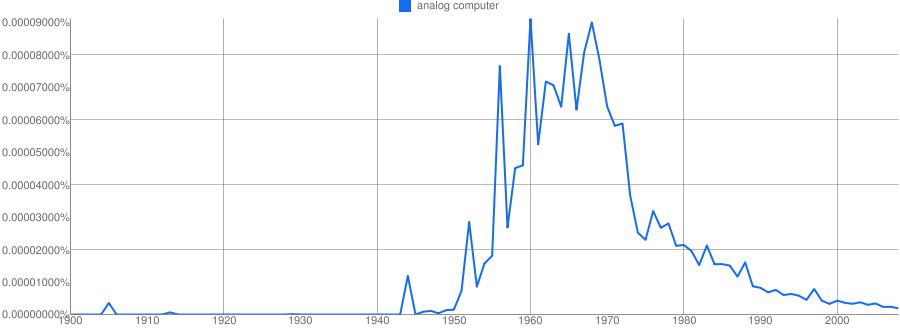
Google offers an interesting service called the "Ngram Viewer" - look how
often the phrase "analog computer" could be found in books between
1900 and 2008:
Youtube has a wonderful collection of historical educational videos
describing the operational principles as well as the usage of
mechanical analog computers as used in fire control and the like
(thanks to David Curran for the links):
"lalbritton" developed a harmonic transformer (a simple mechanical
analog computer generating sine/cosine functions) which is described at
Thingiverse and
in the June 2011 issue of Make.