Car with variable speed


On July 19th, 2008, my friend Dr. Matthias Koch brought a small mathematical problem to my birthday party: Suppose you are driving a car with an initial speed of 100 km/h. You are continuously loosing speed while driving - to be exact, you loose 1 km/h for every kilometer you drove. The question now is, how long does it take to drive 50 km with this style of driving?

The first observation is that dv / ds = -1 since the graph of your speed plotted against the distance is linear, beginning with v = 100 km/h at s = 0 km and ending with v = 0 km/h at s = 100 km. Of course, you will never reach the point s = 100 km, but this is not the problem here since we are interested in the time it takes to reach a distance of 50 km.

Thinking about the graph resulting from plotting the speed versus time it is obvious that v(t) must be of the form exp(-t) since the speed at any distance s is exactly 100 - s.

Since the distance traveled at any time t is just the time integral over v(t) which is of the form 100 * exp(-x), one could write
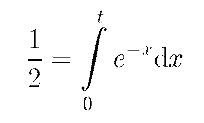
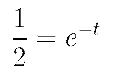
and solve for t to determine the time necessary to travel a distance of 50 km. This is tedious and there is a better way: Since the speed at a distance of 50 km is exactly 50 km/h the question reduces to
which results in a time of approximately 0.693 hours necessary to travel the distance in question.

As nice as this analytical solution is, it would be nicer to have a model of the problem on an analog computer to confirm this result.

What we need is a model of the problem stated above. What do we know? If we assume a scaled model where 100 km will be represented by a machine variable value of 1, we can write v(t) = 1 - s(t) while s(t) is defined as the time integral over v(t).

The straight forward solution would require an integrator with v(t) as its input. The output of this element would be -s(t) since integrators and summers perform a change of sign on most electronic analog computers. Adding 1 to -s(t) using a summer would yield s(t) - 1, so a second summer for another change of sign would be necessary yielding the desired 1 - s(t) which is just v(t) as we found earlier and thus closes the computational loop.

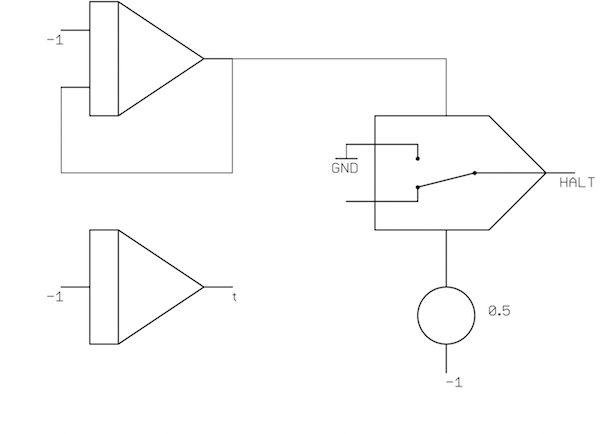
Two summers in a row can be removed since they would change the sign twice, so we can use the summing feature of an integrator which gets and initial value of -1, representing the initial speed of 100 km/h. Its inputs are +1 and its own output, so the integrator will integrate over 1 - s(t) and yield v(t). The corresponding circuit is shown below:

The question remains: When does v(t) equal 50 km/h (or 0.5 in our scaled problem)? To solve this we use a comparator which compares the current v(t) with a fixed value of 0.5. When v(t) reaches 0.5 the comparator will activate its (electronic) switch which is then used to halt the analog computer preserving the current value of v(t) at the output of the integrator shown above.

Unfortunately, we have no time variable in the circuit shown above, so we need another integrator to get a machine time variable:

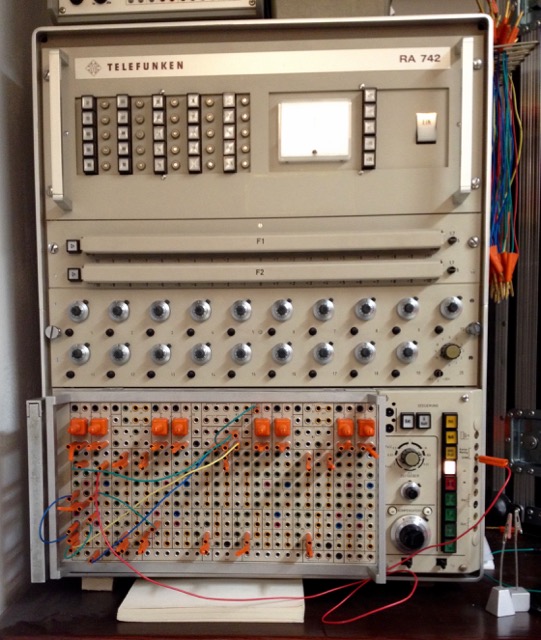
The picture below shows the complete computer circuit - the first integrator on the very left is used to get t (running from -1 to more positive values) while the second integrator solves the actual problem of the slowing car:

Since the particular analog computer I used, a Telefunken RA 742 has a digital extension, a so called DEX 102, the comparator output is not directly available on the analog patch panel but rather on the digital expansion unit. The following picture shows the necessary connection on the digital extension unit to place the computer into Halt mode when v(t) = 0.5 is reached:

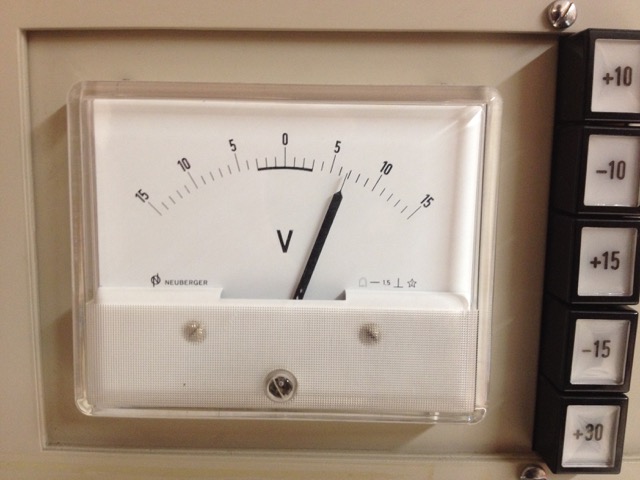
The time span necessary to reach a distance of 50 km can now be read out from the output of the time yielding integrator. Using my beloved old digital voltmeter, I got this reading:

Wait a moment... 0.3825? (Do not forget, 10 V equal the machine value one, so the reading from the digital voltmeter must be divided by 10 first!) Didn't I get the analytical result of about 0.693? Is the result obtained by the analog computer way off? No, it isn't. Having a look at the time signal generating integrator, we see that its initial value is +1, so at the beginning of the simulation, t equals -1. The displayed value of about 0.38 corresponds thus with 1 + 0.38 = 1.38. This does not look better, does it? We now have to know that the time constants of the integrators were chosen in a way that the range -1 <= t <= 1 corresponds to 1 hour of the simulated car ride, so we have to divide 1.38 by 2 which yields 0.69 thus confirming the analytical result gained earlier.

20-JUl-2008, ulmann@analogmuseum.org